@BrendaSPeterson

Twitter


Blog Index
The journal that this archive was targeting has been deleted. Please update your configuration.
Navigation
NEWS FLASH: Audible.com has just put the audiobook of this memoir, narrrated by the author, on sale for $4.99. 

I Want to Be Left Behind interview with the author featured in the New Year's "To the Best of Our Knowledge" podcast "Apocalypse Now

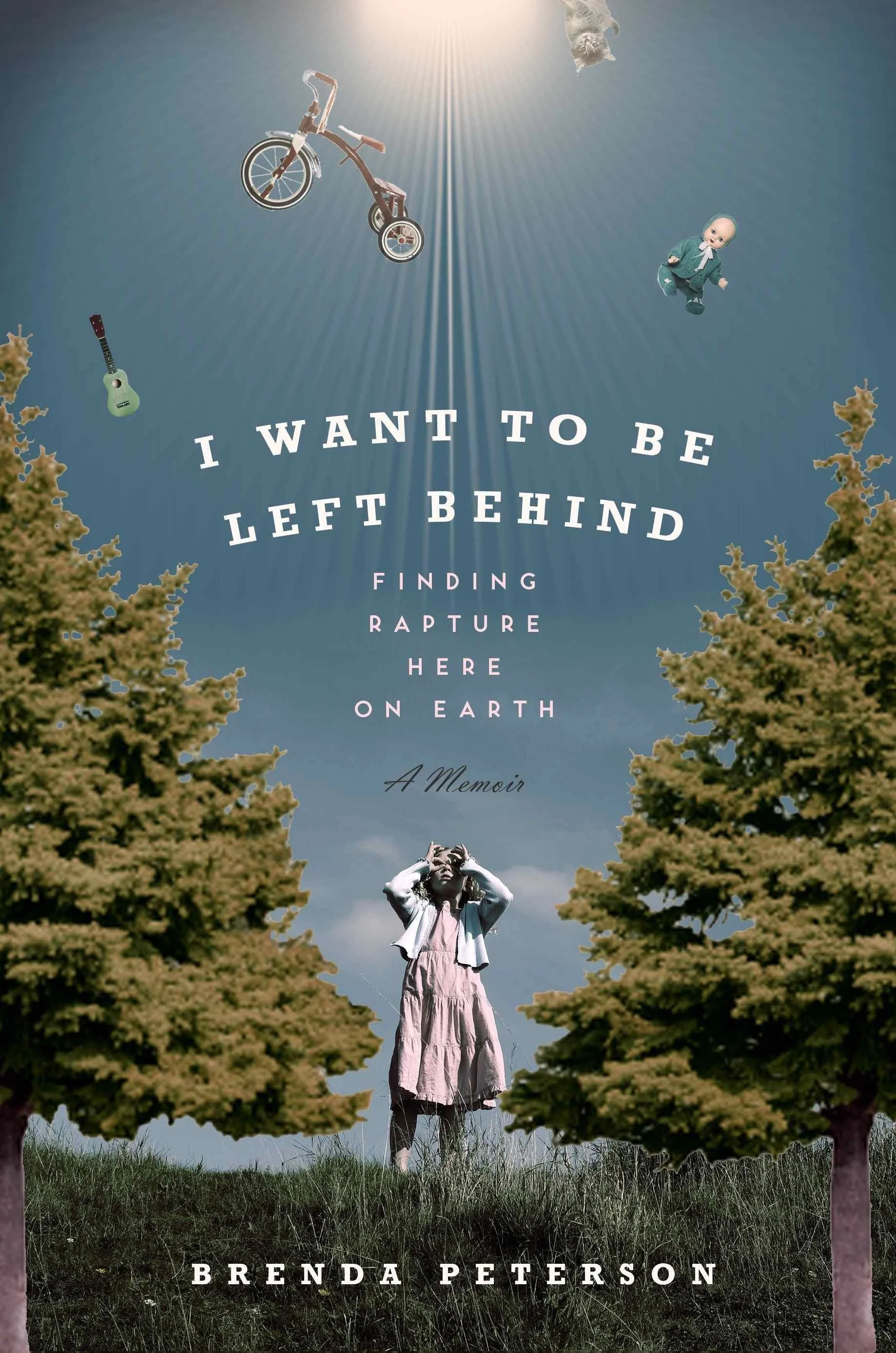
I Want to Be Left Behind
In Brenda Peterson’s unusual memoir, fundamentalism meets deep ecology. The author’s childhood in the high Sierra with her forester father led her to embrace the entire natural world, while her Southern Baptist relatives prepared eagerly and busily to leave this world. Peterson survived fierce “sword drill” competitions demanding total recall of the Scriptures and awkward dinner table questions (“Will Rapture take the cat, too?”) only to find that environmentalists with prophecies of doom can also be Endtimers. Peterson paints such a hilarious, loving portrait of each world that the reader, too, may want to be Left Behind.


 A "Top Ten Best Non-Fiction Book of the Year" ~ The Christian Science Monitor

 Selected by Independent Booksellers nationwide as an Indie Next "Great Read"

Watch Nancy Pearl's "Book Lust" interview on I Want to Be Left Behind

Listen to a recent NPR interview "Finding Common Ground" with Brenda Peterson

Read cover story, "Grounded" in City Arts magazine

Now an audiobook on Audible.com, read by the author


  Praise For I Want to Be Left Behind


Booklist, 12/1/09
“[An] unusually affecting and radiant spiritual memoir… Peterson seeks a meeting of church and earth in this witty, enrapturing account of a spiritual journey of great relevance to us all.”

Kirkus Reviews, 12/1/09
“The author offers a selective memoir that blends her unique autobiography with compassionate and levelheaded observations about family, food, religion, life and our relationships with living things…Peterson has a gift for describing her life’s many adventures with disarming understatement and narrative poise.”

Library Journal, 11/5/09
“This tender, lyrical account of turning away from her religious roots starts with the painful realization that there is no place in a fundamentalist heaven for her beloved animals and the growing sense that her love of the natural world is antithetical to those eagerly anticipating the Rapture. Charting her evolution into an environmental writer of fiction and nonfiction, Peterson always seeks common ground, eschewing fundamentalism of all kinds, whether religious or environmental.”

Publishers Weekly, 1/11/10
“Talk of the rapture surrounds Peterson, and she engages this conversation with delicacy, humor, frustration, and, at times, a begrudging respect, in this memoir.”

City Arts Seattle, February 2010
“Peterson’s I Want to Be Left Behind is a tonic, the least acridly dogmatic of the new God books, pro or con...Her book has humor, which the divine debate could use more of. Instead of another volley in the God wars, her book can be seen as a kind of peace offering. She makes you think maybe everybody is in more harmony than they think.”

Los Angeles Times, 1/31/10
“It is a rich and often lovely life—full of humor and Peterson’s own unique brand of faith.”

Cleveland Plain Dealer, 1/31/10
“Lovely, irreverent humor…Her journey is fascinating, and when she writes about spiritual revelation through nature, she’s captivating...We are left with a good feeling: it is possible to have meaningful discussions with people we don’t agree with and still love them."

Huffington Post, 2/10/10
“With this luminous, surprising memoir, Brenda Peterson completes her own assignment, giving us a story where no one is killed, dismissed, or left behind, where empathy is not only possible but imperative, where rapture can be ours here and now.”

Hudson Valley News, 2/3/10
“A thought-provoking, beautifully written and challenging memoir.”

North Kitsap Sun, 2/14/10
“[A] comedic spiritual memoir.”

Seattle Times, 2/14/10
“[A] thoughtful, witty meditation…Peterson has distilled her life experiences to create the sense of a woman on an idiosyncratic spiritual journey.”

Cleveland Plain Dealer, 2/18/10
“Lovely, irreverent humor…[Peterson’s] journey is fascinating, and when she writes about spiritual revelation through nature, she’s captivating.”

Harborwalk Books, in the Columbus Dispatch, 2/28/10
“At once precocious and thoughtful, [Peterson] weaves her way through the contradictions of growing up to find her own spiritual place in the world. ‘Glowing’ would not be too strong of an adjective for this book!”

The Center of Progressive Christianity website, 3/9/10
“Talk of the rapture…surrounds Peterson, and she engages this conversation with delicacy, humor, frustration, and, at times, a begrudging respect, in this memoir about growing up among Southern Baptists and not quite fitting in.”

HistoryWire.com, 3/8/10
“In a memoir that is truly sui generis, veteran author Brenda Peterson humorously recounts the dynamic tension between her nature-loving parents and her Southern Baptist relatives… [A] big hearted book... Peterson’s memoir is more even-handed than Pollyanish, as she critiques both evangelicalism and holier-than-thou environmentalism. Through it all, the author expresses her deep love and appreciation for nature.

Christian Science Monitor, 3/15/10
“Peterson wraps her story in down-home warmth and a quick wit…Peterson’s stories are gems.”

Miami Herald, 3/21/10
“[An] outstanding memoir…[Peterson’s] vivid imagination combined with a lilting writing style make the book a pleasure to read.” 

Spirituality and Practice website, 3/22/10
“[A] well-written and consistently compelling spiritual memoir.”

Portland Oregonian, 4/4/10
“[Peterson] merges her quest for spirituality with her love of nature…[She] writes with gentle humor of being a stranger in her own family, while highlighting both the beauty and the holiness of our physical world.”

Curled Up With a Good Book, June 2010

“An often pointed, sometimes funny but always thoughtful history of a young girl's quiet rebellion against the noisy (to her) faith of her family.”

EcoPsychology Review, September, 2010

"A powerful and beautiful memoir . . . exquisite storytelling.  Peterson invites the reader through her life story to see ourselves as experienceing rapture here on earth and to realize that this is everything we could ever want."

National Catholic Reporter, 6/19/2012

"A delightfully funny and affectionate family memoir."


Saturday, December 29, 2012 10:00pm To the Best of Our Knowledge interview

Apocalypse, Now

Apocalyptic fiction and doomsday scenarios from celebrated writers. Justin Taylor on "The Apocalypse Reader"; Kevin Brockmeier on "The Brief History of the Dead"; Brenda Peterson on Rapture Here; Margaret Atwood on "The Year of the Flood"; Jim Crace on "The Pesthouse".


FEATURES, City Arts magazine

Grounded.

Brenda Peterson was raised to think that the chosen will be swept into heaven. A new memoir reveals how she reversed her thinking and why she now believes the chosen have muddy feet.


Photography by Andrea J. Walker

In the apocalyptic war between God’s apologists and assailants, Seattle is a major battleground. On God’s side are local writers like Michael Medved and Stephen Meyer, cofounder of the nationally influential agitprop group the Discovery Institute. Meyer’sSignature in the Cell: DNA and the Evidence for Intelligent Design is Amazon’s tenth-best-selling 2009 science book.

Opposing them are writers like Brenda Peterson, whose new memoir, I Want to Be Left Behind: Finding Rapture Here on Earth, critiques her Southern Baptist upbringing; Christian-basher Dan Savage of cable TV and newspaper fame, and Seattle-educated TV star Julia Sweeney, whose autobiographical monologue Letting Go of God is new on Showtime.

The God fight is the central event of our time, splitting our country in half (and the Christian right may soon split the Republican party). Both sides are hopping mad. The Discovery Institute–spawned politician Susan Hutchison claims that when she met best-selling author Richard Dawkins, she tamed his raging atheism by grabbing his face in both hands to make him be nice. He called her “a religious nut.”

In the toxic context of this battle, Peterson’s I Want to Be Left Behind is a tonic, the least acridly dogmatic of the new God books, pro or con. “The problem is, they all get so self-righteous,” says Peterson in her aerie overlooking Alki Beach. Her piercing blue eyes blaze with fervor, but not rage. And her book has humor, which the divine debate could use more of. “Have you ever seen a fundamentalist stand-up comic?” she asks.

Peterson is more of a Northwest mystic than a stand-up comic, but her act has never won more applause. A nature and fiction writer with a respectable pedigree – five years at the New Yorker, one New York Times Notable Book of the Year – she struck a zeitgeist geyser this month with her fifteenth book. It’s earned her best reviews, and it’s her first to be chosen by the American Booksellers Association for the Indie Next best books of the month list. “We’ve had film interest,” she says. Is her suitor a Hollywood name we’ve heard of? “Oh God, yes!” Clearly, Brenda Peterson’s time is at hand.

To understand Peterson, you have to know about America’s most popular new religion: Rapture Christianity. It holds that all Christians will soon be swept alive into heaven, with sinners left behind to be ruled by Satan. Popularized in 1909 by a Kansas City lawyer, Rapture theology reweaves the Bible’s most baffling prophecies into a coherent story and has formed the basis of many literary works, including the popular Left Behind series of novels. Only 39 percent of Americans believe in evolution; 55 percent believe in the Rapture.

“They say it’s biblically literal, but it’s an edit job,” says Peterson. Even as a young Rapture Christian, she had trouble believing it. “It’s the flip side of Islamic fundamentalism. Each longs for a paradise beyond this earth, and shows no mercy for those left behind.”

Peterson preferred earth to heaven, partly because her Forest Service father raised her in a series of natural paradises. “I was born on a lookout in the High Sierra on the Oregon-California border. There were only ten of us there – it was pretty hard to be too human-centric. The forest got to me before the faithful did. I assumed that everyone experienced the daily raptures I felt.” She couldn’t see the Rapture for the trees, which her dad called “the Standing People.”

“My family loved animals and nature, “ she says. “It was a paradox – if they loved the world, why were they so eager to leave?” Peterson got booted out of Vacation Bible School for thinking flying squirrels miraculous. She was outraged to hear that animals would get left behind. “Why whisk only humans off to heaven? What kind of Rapture was that?”

When she was in the third grade, her father took a fellowship and whisked the family off the mountaintop. “We put on shoes and went to Harvard. It was a shock.” Then it was off to Montana, then Virginia. “I went to sixteen different schools.”

Even when they were not in the Bible Belt, her family was a traveling bubble of Southern Baptist values. But their Rapture lessons failed to take, and nature remained her true religion. When she snuggled in her Montana Sunday School teacher’s grizzly-bear fur coat to get warm, she felt close to the grizzly, but the Bible lesson left her cold. While working at what she calls “a Southern Baptist boot camp” in New Mexico, she got fired for bringing food to indigent native tribes and writing a poem called “Jesus Had Dirty Fingernails.”

Her dad complained, “Your mind is so open it’s one big hole.” But as she points out, “It’s hard for dogma to take hold when you’re constantly in culture shock.” In tenth grade, they moved to Berkeley. It was the ’60s, when folks were beginning to call it Berserkley. “That’s when my family thinks I got lost. I actually got found.”

She was discovered by her University of California writing professor, Diane Johnson (Le MariageThe Shining screenplay). In 1972, Peterson speed-typed her way into a coveted job in the New Yorker typing pool, rife with future novelists. “It had its own dogma, language, dress code.” It wasn’t a magazine, it was a religious order, and novice Peterson worshipped literature under legendary editors Mr. Shawn, Jonathan Schell and Pauline Kael. “[Pauline] put her elbows into my shoulder and leaned over to make sure every word of her Last Tango in Paris review was correct.” It was like a mad monastery: one writer lived in the ladies’ room; another imprisoned his mom in his office; a third knocked Peterson and editor Edith Oliver over with a bookshelf. “They were all so eccentric, but it gave me permission to understand that art is all about imagination – not answers, it’s all about questions.”

But it was tough to live on eighty-eight dollars a week – as a shocked Oliver gasped, “You mean you live on your salary?” Peterson puzzled her urban colleagues by planting a garden inside the New Yorker office. At the chilly dawn of Ann Beattie minimalism, the fiction department was stony soil for Peterson’s Southern-fried maximalist imagination. Her boss said, “Lose the Southern accent, people will think you’re stupid. Start covering Manhattan cocktail parties.” Peterson didn’t drink, which was like refusing to take communion. Her first novel, River of Light, had Bible Belt characters who said things like, “It’s rainin’ like a cow pissin’ on a flat rock.” Not in Mr. Shawn’s magazine they didn’t.

In 1978, God smiled on Peterson. New Yorker editor Rachel McKenzie, discoverer of Muriel Spark and Philip Roth, volunteered to edit Peterson’s book for free. “I said, ‘Oh, thanks!’ I didn’t realize it was thousands of dollars’ work she was offering.” And more: McKenzie hooked her up with John Updike and Julia Child’s editor at Knopf, the magazine’s preferred publisher.

McKenzie’s fondly inscribed portrait rests on Peterson’s desk in Seattle, where she’s lived since 1981 – longer than anywhere else on earth, her own promised land. She looks out on an Alki beach she’s helped make a National Wildlife Federation sanctuary for baby seals, watched over by her group, the Seal Sitters. “It’s just neighborhood folks taking care of seal pups while their mothers are fishing.” The scene is the subject of her next book, Pups on the Beach, due out next year.

I Want to Be Left Behind begins and ends on this beach, where she and her Rapture Christian seal-sitter friend George debated the End Times while trying to keep pups alive. She told George, “We would all miss you so much if you zipped up to heaven. We’d say, ‘Well, there goes the neighborhood.’”

Peterson’s is a more loving rejection of Rapture Christianity than most of its opponents can manage. Her environmentalism is also cheerier than is typical these days. “Environmentalists have become increasingly fundamentalist,” she complains, “full of fundamentalist End Time scenarios. I think people are tired of being scared to death, of red alerts and orange alerts.  I want to be here on earth exploring and imagining other futures than extinction or heaven. Our religions are too focused on fear and death instead of life and joy.”

Peterson loves to get together with her Christian relatives and sing old hymns like “This World Is Not My Home, I’m Just Passin’ Through,” even though this world is her home. She says they argue constantly, “as if their afterlives depended on it.” But in between, they sing hymns in multipart harmony.

Instead of another volley in the God wars, her book can be seen as a kind of peace offering. She makes you think maybe everybody is in more harmony than they think. Who knows? Maybe the arguers are actually singing to the glory of what some call God.

In any case, I Want to Be Left Behind proves Peterson’s old college anthropology professor was right. He said, “She has a gift for rapture.” •